
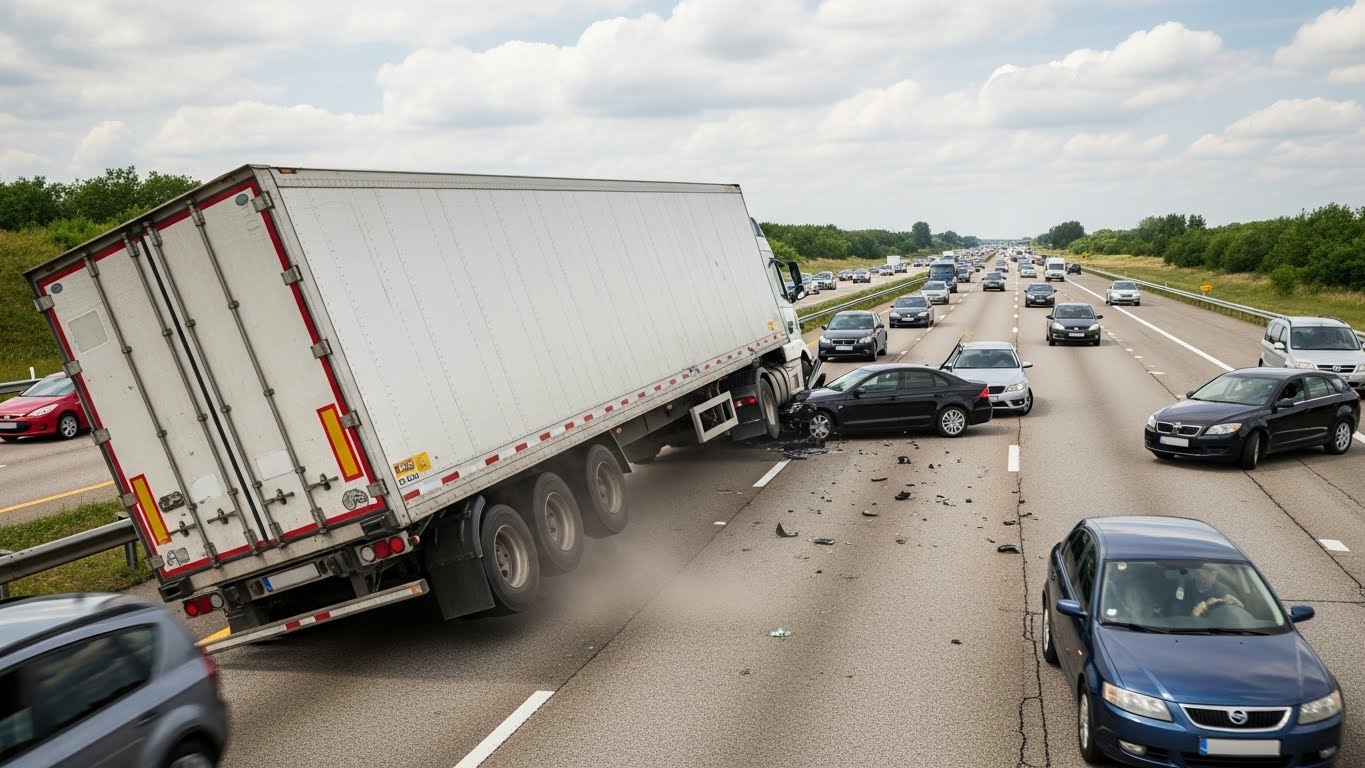

When a massive commercial vehicle begins to lose its alignment, the transition from a straight path to a dangerous fold happens almost instantly. These events are terrifying for everyone on the road because a trailer that was following a tractor moments ago suddenly becomes a giant, uncontrollable swinging arm. The physics involved are relentless, and once the process begins, it is incredibly difficult to stop.
Most drivers do not realize how little time they have to react when a heavy load starts to shift its weight. A minor slide that might be manageable in a passenger car becomes a catastrophic force when it involves tens of thousands of pounds of freight. This loss of coordination between the cab and the cargo is what makes these incidents so uniquely hazardous for highway traffic.
The geometry of a tractor trailer is designed for forward motion, but it becomes a liability the second that traction is compromised at a critical point. Understanding the mechanical triggers is the only way to appreciate the danger these vehicles pose when things go wrong. Most multi-vehicle pileups are the direct result of jackknife truck accidents that block every available lane.
Loss of Trailer Stability
Stability in a commercial rig depends entirely on the rear wheels of the tractor maintaining a firm grip on the pavement. If those drive wheels lose traction while the trailer is still moving forward with significant momentum, the entire unit loses its structural integrity. The trailer essentially tries to overtake the cab, pushing the rear of the tractor out to one side.
This trailer swing is the beginning of the end for the driver’s ability to steer the vehicle effectively. As the angle between the cab and the cargo increases, the center of gravity shifts in a way that the rig was never meant to handle. The momentum of the heavy load acts like a giant pendulum, swinging wide and sweeping across multiple lanes of traffic.
Once the trailer has moved beyond a certain angle, it begins to exert a sideways force on the fifth wheel hitch. This connection point is strong, but it cannot withstand the lateral pressure of a fully loaded trailer sliding at highway speeds. The result is a violent folding motion that can easily crush smaller vehicles caught in the path of the swinging metal.
Braking and Speed Imbalance
Improper use of the braking system is one of the most common ways to initiate a dangerous slide on the highway. If a driver slams on the brakes too hard, the wheels on the tractor may lock up while the trailer continues to roll forward. This creates a massive imbalance in forces that forces the trailer to pivot around the hitch point.
Speed also plays a massive role in how quickly a situation transitions from a minor slip to a total loss of control. High speeds magnify every small steering input and every minor loss of grip, making the margin for error almost nonexistent. A driver who is traveling too fast for their load weight will find that the trailer has much more influence over the cab.
Modern anti-lock braking systems are designed to prevent this exact scenario, but they are not infallible against the laws of motion. If the mechanical components are not perfectly maintained or if the load is unbalanced, the brakes can still cause a skid. Maintaining a consistent speed and using gradual braking pressure are the only ways to keep the two units moving in sync.
Road and Weather Amplifiers
External conditions often serve as the final nudge that sends a heavy commercial vehicle into a tailspin. Rain, snow, and ice drastically reduce the coefficient of friction between the tires and the road surface, making traction much harder to maintain. In these environments, even a perfectly maintained truck is at a much higher risk of experiencing a sudden slide.
High winds are another invisible enemy that can catch a driver off guard, especially when the trailer is empty or carrying a light load. A strong gust hitting the side of a tall trailer acts like a sail, pushing the unit out of its lane. This lateral movement can easily trigger a jackknife if the driver overcorrects or brakes suddenly in response.
Poorly maintained roads with deep ruts or standing water add another layer of complexity to the stability equation. Hydroplaning is particularly dangerous for trucks because it can affect the tractor and trailer differently at the same time. When the wheels lose contact with the pavement, the rig is essentially floating, and the heavy trailer will follow the path of least resistance.
Why Recovery Is Nearly Impossible Mid-Event
Once the angle of the fold reaches about fifteen degrees, the physics of the situation become almost impossible to overcome. At this stage, the force of the trailer pushing against the tractor is greater than the friction available to the tires. No amount of steering or braking by the driver can pull the vehicle back into a straight line.
Many drivers instinctively try to steer into the skid or slam on the brakes, but these actions often make the folding motion even more violent. The cab is being pushed sideways, and any attempt to fight that movement can result in a rollover. The momentum is simply too great for the mechanical systems of the truck to counteract once the pivot has begun.
The point of no return happens faster than most people can process what is occurring in front of them. Bystanders often wonder why the driver didn’t just steer out of it, but the reality is that the truck is no longer a steered vehicle. It has become a collection of heavy objects governed entirely by kinetic energy and the angle of the slide.
Conclusion
Jackknife events represent one of the most dangerous failures that can occur on a high speed roadway today. They transform a predictable vehicle into a chaotic obstacle that can destroy everything in its immediate path within a few seconds. The combination of massive weight and high momentum creates a force that is nearly impossible to contain once it breaks loose.
Preventing these disasters requires a constant awareness of road conditions and a deep respect for the limits of truck mechanics. Drivers must be vigilant about their speed and braking habits, especially when weather conditions are less than ideal. A small mistake in judgment can lead to a chain reaction of damage that affects dozens of lives.
Ultimately, these crashes serve as a sobering reminder of the power inherent in the logistics that keep our world moving. While technology continues to improve vehicle safety, the fundamental rules of physics still dictate what happens during a loss of stability. Respecting the space around these large rigs is the only way for other motorists to stay safe.