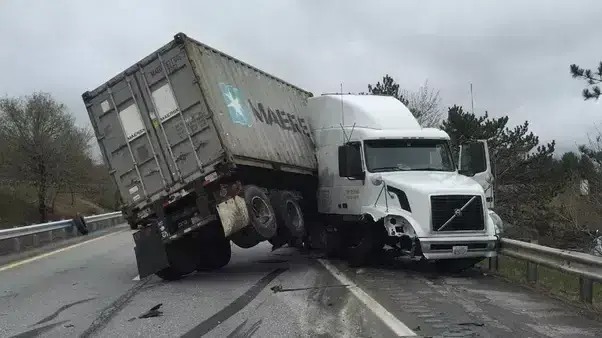

A jackknife truck accident happens when a large truck’s trailer swings out to the side and forms a sharp angle with the cab, similar to a folding pocketknife. This usually occurs when the truck loses traction or the driver brakes suddenly. When the trailer skids sideways, the driver often loses full control of the vehicle.
Because of their size and weight, jackknife truck accidents can block multiple lanes of traffic and cause severe multi-vehicle crashes. These accidents are especially dangerous on highways where vehicles travel at high speeds.
Understanding how these crashes happen and why they are so serious can help drivers stay alert and avoid dangerous situations around large trucks.
How a Jackknife Accident Happens
To understand the danger, it helps to first look at how these accidents occur. A commercial truck has two main parts: the cab (front) and the trailer (back). They are connected by a coupling device that allows the trailer to pivot.
Normally, this design allows trucks to turn safely. However, when something disrupts traction—such as hard braking or slippery roads—the trailer’s wheels may lock up. When this happens, the trailer can swing outward.
Several common causes include:
- Sudden or hard braking
- Driving too fast for weather conditions
- Slippery roads from rain, snow, or ice
- Improperly loaded cargo
- Equipment failure, such as brake problems
Once the trailer begins to swing, it can quickly move across lanes. The driver may not be able to straighten the truck before hitting other vehicles.
Why Jackknife Accidents Are So Dangerous
Now that we know how they happen, let’s look at why they are especially dangerous.
They Block Multiple Lanes
When a trailer swings out, it often stretches across two or more lanes. On busy highways, this creates an instant roadblock. Drivers behind the truck may not have enough time to stop.
This can lead to:
- Chain-reaction crashes
- Rear-end collisions
- Side-impact crashes
- Vehicles being trapped under the trailer
The size of a commercial truck makes these collisions much more severe than typical car accidents.
They Happen Quickly
A jackknife can develop in just seconds. Other drivers may not see warning signs before it happens. Even if they react quickly, stopping at highway speeds takes time and distance.
Because of this, surrounding vehicles often become part of the crash.
The Weight of the Truck Increases Impact
Fully loaded semi-trucks can weigh up to 80,000 pounds. When that much weight moves sideways across a highway, the force is enormous.
Passenger vehicles are much smaller and lighter. In a collision with a jackknifed truck, cars can be crushed or pushed off the road.
Weather Makes Jackknifing More Likely
Weather plays a major role in these accidents. Rain, ice, and snow reduce tire traction. When traction decreases, it becomes easier for wheels to lock up during braking.
For example:
- Wet roads increase stopping distance.
- Ice causes wheels to lose grip instantly.
- Strong winds can push trailers sideways.
Truck drivers must adjust their speed during poor weather. If they do not slow down, the risk of jackknifing increases significantly.
Driver Error and Equipment Issues
Although weather is a factor, driver behavior is often involved.
Common driver-related causes include:
- Following too closely
- Speeding
- Improper braking techniques
- Inexperience
Truck drivers are trained to use controlled braking methods. Slamming on the brakes can cause the trailer to swing. Modern trucks may have anti-lock braking systems, but even these systems cannot prevent every skid.
In addition, mechanical problems can contribute to jackknife accidents. Worn brakes, uneven tire pressure, or poor maintenance can all reduce vehicle control.
Injuries and Damage From Jackknife Crashes
Because these crashes often involve multiple vehicles, injuries can be serious.
Common injuries include:
- Head and brain injuries
- Spinal cord injuries
- Broken bones
- Internal injuries
- Severe cuts and bruises
In the worst cases, jackknife accidents can be fatal.
Property damage is also significant. A jackknifed truck may damage several vehicles, highway barriers, and nearby structures.
How Drivers Can Reduce Risk
While passenger vehicle drivers cannot control truck drivers, they can take steps to reduce risk.
Safety tips include:
- Avoid driving in a truck’s blind spots.
- Keep a safe following distance.
- Slow down in bad weather.
- Watch for signs of unstable trailers, such as swaying.
- Never cut in front of a large truck suddenly.
Truck drivers also play a major role by:
- Maintaining safe speeds.
- Braking gradually.
- Inspecting equipment regularly.
- Securing cargo properly.
When both truck drivers and passenger vehicle drivers act responsibly, the risk of serious accidents decreases.
Key Takeaways
- A jackknife truck accident happens when a truck’s trailer swings out and forms a sharp angle with the cab.
- Sudden braking, slippery roads, speeding, and equipment failure are common causes.
- These crashes are dangerous because they block multiple lanes and happen quickly.
- The massive weight of commercial trucks increases the severity of injuries and damage.
- Bad weather significantly raises the risk of jackknifing.
- Safe driving, proper maintenance, and keeping distance from trucks can help prevent accidents.