

Automotive safety technology has advanced significantly over the last few decades, saving countless lives on the road every day. The three-point seatbelt is widely considered the most effective safety device ever invented for passenger vehicles. It is the first line of defense against the violent forces of a collision for everyone.
However, the very mechanism designed to save a life can occasionally become a source of profound physical trauma during a crash. While restraints prevent ejection and high-speed impacts with the dashboard, they concentrate massive amounts of energy onto specific areas of the human body. This paradox is a reality that many accident survivors must face during recovery.
Medical professionals and safety experts study these patterns to improve vehicle design and emergency response protocols for the public. Understanding the mechanics of a seatbelt injury is essential for identifying hidden internal damage that might not be visible immediately after a wreck. Knowledge is the key to a full and healthy recovery.
How Crash Forces Affect the Body
The physics of a high-speed collision involve a sudden and violent transfer of kinetic energy that the body cannot easily absorb. When a car stops abruptly upon impact, any unrestrained object inside continues to move forward at the original speed. The seatbelt’s job is to arrest this motion as safely as possible.
To stop a person weighing several hundred pounds in a fraction of a second, the belt must exert a tremendous amount of force. This pressure is concentrated along the narrow path of the polyester webbing across the chest and the lap. The skeleton and soft tissues must bear the entire load of the deceleration.
While the belt prevents the head from hitting the steering wheel, the torso remains pinned back against the seat. This creates a shearing effect where the internal organs continue to move forward while the frame is held stationary. This internal struggle is what leads to the most serious types of trauma.
Common Types of Seatbelt-Related Injuries
Thoracic injuries are among the most frequent complications seen in patients who were properly restrained during a major frontal impact. The shoulder strap can compress the ribcage with enough force to cause multiple fractures or a bruised sternum. These injuries make breathing difficult and require a very long time to heal.
Abdominal trauma occurs when the lap belt is pushed deep into the soft tissues of the belly during the crash. This can lead to lacerations of the liver, spleen, or intestines, which are often life-threatening if not caught by doctors. The “submarine effect” describes when a passenger slides under the belt entirely.
Spinal injuries, specifically Chance fractures, are a hallmark of severe restraint-related trauma in the lower back region of the body. The spine acts as a hinge during the impact, causing the vertebrae to pull apart under the extreme tension. These injuries require specialized care and often involve a very complex recovery.
Improper Fit and Defective Restraints
The effectiveness of a seatbelt depends heavily on how it is positioned across the sturdy bones of the pelvis and chest. If a lap belt is worn too high on the stomach, the risk of organ damage increases significantly during a stop. Proper adjustment is a mandatory requirement for safety.
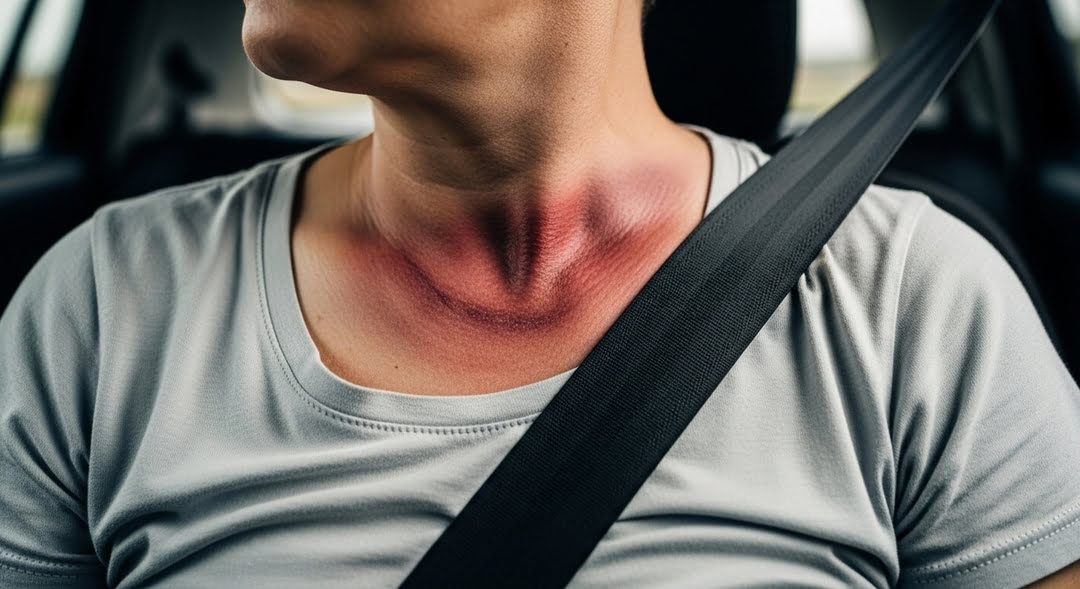
Children and smaller adults are at a higher risk of injury if the shoulder strap crosses the neck instead of the collarbone. In a crash, this misplaced webbing can cause severe vascular damage or even airway obstruction in a matter of seconds. Using boosters and adjusters is the only way to prevent this.
Defective components, such as failing retractors or faulty pre-tensioners, can also contribute to the severity of an injury during an accident. If a belt fails to lock or provides too much slack, the body can hit the interior of the car. Mechanical integrity is just as important as the design itself.
Linking Injuries to Crash Mechanics
Forensic medical experts use the pattern of bruising on a victim’s skin to reconstruct the exact forces of the collision. The “seatbelt sign” is a diagonal bruise that follows the path of the restraint across the torso and hips. This mark is a critical indicator of potential internal organ damage.
By analyzing the location and depth of these bruises, doctors can prioritize which diagnostic tests are needed for the patient. A dark mark across the abdomen often prompts an immediate CT scan to check for hidden bleeding or perforations. The physical evidence on the skin tells a factual story.
Linking these injuries to the specific mechanics of the crash helps in both medical treatment and legal documentation for the victim. It proves that the trauma was a direct result of the restraint system’s interaction with the body. Accurate forensic evidence is the bedrock of a successful and fair claim.
Conclusion
Recognizing that seatbelts can cause specific injuries does not diminish their status as essential life-saving tools for all drivers. The injuries caused by a belt are almost always preferable to the catastrophic results of being thrown from a vehicle. Context is everything when evaluating automotive safety and personal risk.
Ongoing improvements in pretensioner technology and load-limiting retractors are helping to reduce the severity of these restraint-related traumas for passengers. Manufacturers are constantly looking for ways to spread the crash forces more evenly across the body. This evolution saves more lives and reduces long-term disability for everyone involved.
Ultimately, understanding the risks allows for better preparation and more informed medical care in the aftermath of a serious vehicle collision. Staying buckled up remains the best choice anyone can make before starting the engine and heading out. Safety is a journey that requires constant attention to every single detail.