
Reducing vehicle weight is an important consideration in automotive design. A lighter structure can contribute to lower energy consumption, while in electric vehicles it can help make more efficient use of the energy stored in the battery. Achieving this goal, however, is not simply a matter of replacing heavy materials with lighter ones. Engineers need to balance weight with mechanical performance, safety, durability, manufacturability and cost. This is why polymer materials, including injection-molded thermoplastics and lightweight foams such as EPP and EPS, have found applications throughout modern vehicles.
Why does vehicle weight matter?
Every component contributes to the total mass of a car, from the body structure and powertrain to seats, interior trim and luggage compartment elements. Reducing the weight of individual parts can therefore produce cumulative benefits when considered across the entire vehicle.
Lightweighting is particularly relevant when engineers are trying to improve vehicle efficiency without compromising functionality. In electric cars, weight is also an important factor because the battery itself adds considerable mass. This encourages manufacturers to look for savings in other areas of the vehicle.
Material selection is consequently an optimization process rather than a simple search for the lightest available option. A component must still meet its functional requirements and withstand the conditions expected during its service life.
Thermoplastics as an alternative for complex components
Injection-molded thermoplastics provide designers with considerable freedom in creating complex geometries. Materials such as PP, ABS, PS, PC and PC/ABS can be used for different automotive applications depending on the required properties of the component.
One advantage is the possibility of integrating several functions into a single molded part. Features required for assembly or connection with neighboring components can potentially be incorporated into its geometry. In suitable applications, this can help reduce the number of separate elements and simplify the finished component.
The final result depends not only on the polymer itself but also on component design and manufacturing technology. Cooperation with a plastic car parts manufacturer can therefore begin at the engineering stage, when factors such as geometry, material selection, mold design and manufacturability can still be considered together.
Injection molding is only one part of the broader role of polymers in lightweight vehicle construction. Expanded materials offer a different set of properties and can be used where very low density needs to be combined with other functional requirements.
How do EPP and EPS contribute to lightweight design?
Expanded polypropylene (EPP) and expanded polystyrene (EPS) consist largely of air contained within a cellular structure. Their low density makes them particularly interesting where reducing component weight is a priority.
EPP combines low weight with energy absorption and thermal and acoustic insulation properties. It can also recover its shape after repeated deformation within appropriate loading conditions. These characteristics allow molded EPP components to perform functions that go beyond simply filling an empty space.
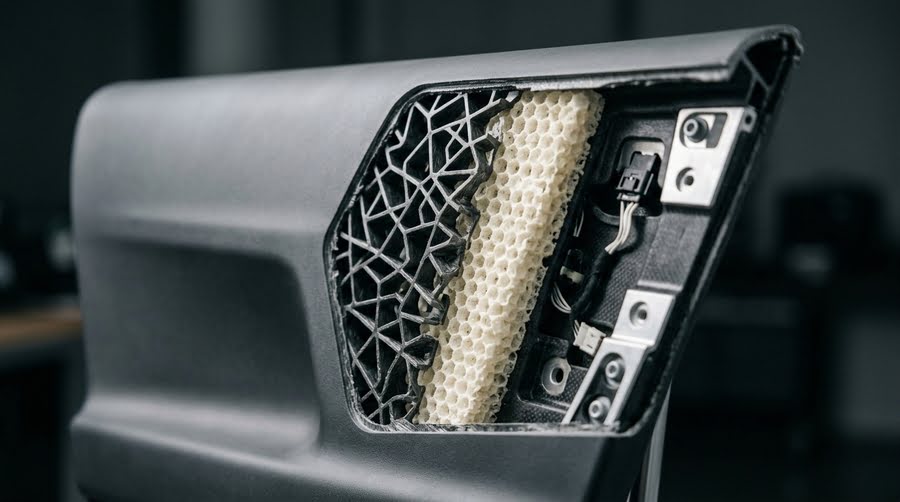
In automotive applications, expanded foams can be found in areas such as seats, floors, doors, cockpits and luggage compartments. They can also form energy-absorbing elements designed to manage loads during an impact. EPS is another lightweight foam used where its particular combination of low density, insulation and energy-absorbing characteristics matches the requirements of the application.
The important point is that injection-molded thermoplastics and expanded foams should not be treated as interchangeable materials. Their properties and production processes differ, so each is suited to different functions within a vehicle.
Lightweighting is about function, not just material density
Replacing a component with a lighter material does not automatically produce a better design. Engineers also need to consider stiffness, dimensional stability, temperature exposure, impact behavior, assembly requirements and expected loads. A lightweight material is useful only when the finished component continues to perform its intended function.
This makes component design particularly important. Geometry can influence mechanical performance as much as the choice of material itself. Ribs, wall thicknesses, local reinforcements and connections with adjacent parts all affect how a component behaves.
The same principle applies to manufacturing. A design should be evaluated in relation to the intended production process from an early stage. Doing so can reveal unnecessary complexity and reduce the risk that a theoretically lightweight solution becomes difficult to manufacture consistently on an automotive scale.
Combining materials for more efficient vehicle design
There is no single material capable of meeting every requirement in a modern car. Metals remain essential for many structural applications, while thermoplastics, EPP, EPS and other materials perform different roles according to their properties.
For this reason, effective lightweighting is increasingly about placing the right material in the right application. Injection-molded polymers can provide complex shapes and functional integration, while expanded foams can deliver very low weight together with insulation or energy absorption.
Viewed this way, reducing vehicle mass is not based on one dramatic substitution. It is the result of numerous engineering decisions made across the vehicle. By selecting materials according to the actual function of each component and considering production requirements from the beginning, manufacturers can reduce weight while retaining the performance expected from a modern vehicle.