
You just closed the deal on a used F-250 or F-350 with the 6.7 Powerstroke. It’s a great truck, one of the most capable diesel pickups on the road, but if you bought it used, odds are it’s running at maybe 70% of what it’s capable of. The previous owner probably didn’t tune it. The DPF is likely partially clogged. The EGR system has been cooking itself for 80,000 miles.
The good news is that the 6.7 Powerstroke is one of the most well-supported diesel engines in the aftermarket. There’s a clear, proven upgrade path that experienced diesel owners follow right after buying a used Super Duty, and it doesn’t require a $10,000 build budget to feel a real difference.
Here’s what to do first, why each upgrade matters, and how to sequence your spending so you’re not throwing money at a truck that isn’t ready for it.
1: Audit the Basics Before You Spend a Dollar on Performance
This is the step most new diesel owners skip. Before touching any performance upgrade, you need to know what you’re actually working with.
On a used 6.7 Powerstroke, pull both fuel filters, inspect the coolant degas bottle for oily contamination, and check whether the DEF tank has been maintained properly. If the truck was towed hard, pull the transmission fluid too.
This audit usually takes an afternoon and costs next to nothing. But it tells you whether your truck needs maintenance first or whether it’s actually ready for performance upgrades. Skipping this step is one of the most common mistakes used diesel buyers make.
2: Cold Air Intake + Exhaust — The Baseline Power Unlock
Once you’re confident the truck is mechanically sound, the first real performance move is intake and exhaust. These two work together and they’re the foundation every other upgrade builds on.
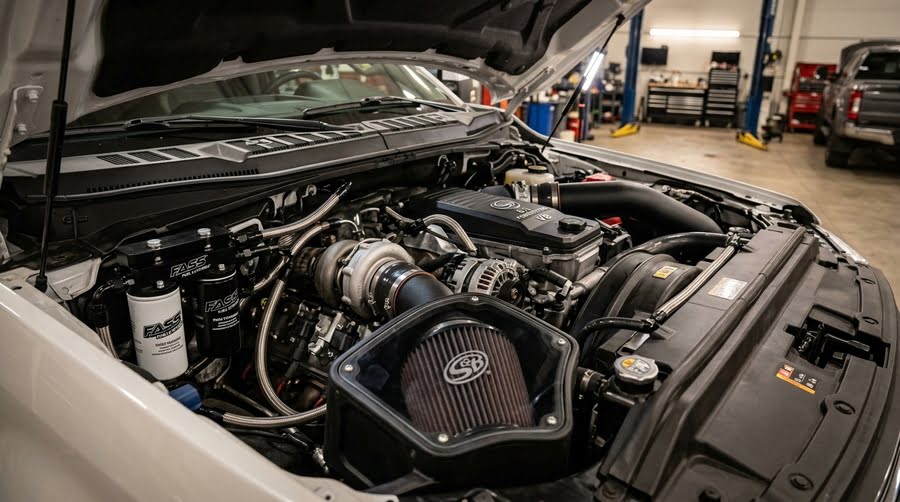
A quality cold air intake gets denser, cooler air into the combustion chamber, which means more efficient fuel burn, better turbo spool, and improved throttle response. On a 6.7 Powerstroke, this is immediately noticeable when you’re merging on the highway or pulling out of a stoplight with a trailer behind you.
On the exhaust side, upgrading to a larger downpipe and a mandrel-bent turbo-back system reduces exhaust backpressure. The turbo spools faster, the engine breathes easier, and you stop losing power to a system that was designed around emissions compliance rather than performance.
Together, these two upgrades are usually the first things diesel owners feel after the purchase, and they cost significantly less than engine or fuel system work.
3: EGR and DPF Delete + Tune
This is the upgrade that comes up in every Powerstroke forum thread, every diesel Facebook group, and every conversation at the fuel island between truck owners. And there’s a reason for that.
The EGR system and DPF on the 6.7 Powerstroke are the two most failure-prone components on the entire truck. EGR cooler failures are well-documented across every generation of the 6.7. A cracked or leaking EGR cooler can contaminate your coolant, destroy your engine, and hand you a repair bill that exceeds $3,000 at a dealer. DPF clogging causes regen cycles that reduce fuel economy and put excess heat into the drivetrain. DEF system faults can put your truck in limp mode at the worst possible time.
For trucks operated off-road, on private property, or on a closed course, the most effective way to eliminate these failure points is a complete 6.7 Powerstroke delete kit. This purpose-built hardware package removes the EGR, DPF, and DEF system components and replaces them with parts designed for unrestricted airflow and reduced under-hood heat. This doesn’t just solve the immediate failure risk; it also extends engine longevity by keeping combustion temperatures lower and reducing the carbon contamination that EGR recirculation causes over time.
One thing worth emphasizing: buy your delete hardware from a supplier that actually specializes in diesel. Fitment matters on this stuff, especially the coolant line routing on the EGR side and the sensor delete plates. A supplier focused specifically on Ford Powerstroke aftermarket parts will carry the correct configuration for your exact model year. The 2011–2014, 2015–2019, or 2020+ all have differences that a generic parts retailer won’t account for.
4: Tune It — The Step That Makes Everything Else Work
A performance tune on a diesel truck isn’t optional. It’s the upgrade that activates everything else you’ve done.
The stock ECU calibration on a 6.7 Powerstroke is engineered for emissions compliance. That means fuel timing, boost targets, injection pressure, and torque limits are all dialed back from what the engine is actually capable of. On a truck that’s been deleted and fitted with an intake and exhaust, running the factory tune means the ECU is still fighting your hardware.
A proper custom diesel tune recalibrates all of those parameters to match your actual build. On a deleted truck, tuning is required for the system to function correctly. On a stock or lightly modified truck, a performance tune alone can add 60–100 lb-ft of torque and meaningfully improve towing response.
Popular platforms for the 6.7 Powerstroke include EZ Lynk and SCT X4 for more straightforward canned tune applications. If you’re towing regularly, look for a tuner that offers dedicated tow profiles alongside performance and economy options.
5: Transmission Cooler — The Upgrade Most Towers Miss
The 6R140 TorqShift is a capable transmission, but it doesn’t like heat. If you’re pulling anything over 14,000 lbs regularly, transmission fluid temperature is the slow-burn issue that ends used diesel truck builds prematurely.
An upgraded auxiliary transmission cooler runs $150–$300 and is one of the highest-value per-dollar upgrades for any serious tow rig. Combine it with a transmission tune and you have a drivetrain that holds up under serious long-haul towing conditions.
The Right Order Matters More Than the Budget
Here’s the priority sequence most experienced diesel owners follow:
- Full fluid and filter audit
- Cold air intake + exhaust
- EGR/DPF delete (off-road) + ECU tune
- Transmission cooler upgrade
- Injectors or CP4.2 fuel pump (higher-mileage builds)
The 6.7 Powerstroke responds better to aftermarket work than almost any other diesel on the market, which is a big part of why used Super Duty trucks hold their resale value the way they do. But the sequence matters. Get the foundation right, eliminate the known failure points, and tune for your actual hardware configuration. Do it in that order and you’ll have a truck that runs stronger, lasts longer, and tows harder than it did the day it rolled off the assembly line.